
HOMESTEAD LIFE ✦ BAT HOUSE SERIES
Where to Mount a Bat House — And Every Spot We Ruled Out First
Turns out picking the right location matters more than which house you buy. Here’s how we figured that out the hard way.
Figuring out where to mount a bat house on our small homestead turned out to be more complicated than I expected. I assumed we’d just pick a spot on the barn and call it done. What actually happened was a full property walkthrough where we ruled out four locations before landing on the right one — and learned something useful at every stop.
If you missed Part 1 of this series, we’re putting up bat houses this summer because our mosquito situation has officially gotten out of control. We have Nigerian Dwarf goats, which means low water tanks, which means no fish to eat the larvae. My sister and kids are allergic and getting quarter-size welts. Even I’m getting bitten now, and I am normally the person mosquitoes ignore entirely. We decided to try working with nature instead of reaching for a fogger — and bat houses were the answer.
The houses aren’t up yet — we’re still waiting on the order. But I did all the research on placement first, walked every building on our property and my mom’s next door, and I want to share what we figured out before we even put a single screw in the wall.
🦇 Why Placement Matters More Than Which House You Buy
I spent a lot of time in Part 1 comparing bat houses. But here’s the thing I didn’t fully appreciate until I started researching installation — a perfectly good bat house in the wrong spot will stay empty for years. Bats are picky about their roosts in ways that have nothing to do with the house itself.
The three things that matter most, in order:
1. Sun exposure. Bats need warm roosts — especially mother bats raising pups. A bat house needs 6 to 8 hours of direct sun daily. South and southeast facing walls are ideal. North facing is the worst possible option. This one fact alone ruled out three of our buildings immediately.
2. Height. The house needs to be at least 12 to 15 feet off the ground — higher is better. Too low and predators can reach it. Too low and bats don’t feel safe dropping into flight from the entrance.
3. Clear flight path. Bats drop from the entrance and fly downward before pulling up into flight. They need open air below and around the house — no tree branches, no fences, no obstacles within 15 to 20 feet.
🦇 Our Property Walkthrough — Every Spot We Considered
We have a few buildings on our small homestead and I genuinely thought this would be easy. It was not. Here’s how each one went:
My husband’s shop: Nice tall walls at 14 feet — perfect height. But we walked all four sides and not one of them worked. North wall faces the garden but gets no direct sun. East wall faces the street — too much activity and only morning sun. West wall has the bay doors — opening and closing them all day would stress a bat colony right out of there. South wall has trees right up against it blocking the sun completely. The shop was a hard no on every side.
My barn: The front of the barn has trees overhanging the roofline — predator highway, ruled out immediately. The back of the barn faces west, which gets good afternoon sun. In Kansas summer that afternoon sun is intense enough to heat a bat house adequately. This is our backup option.
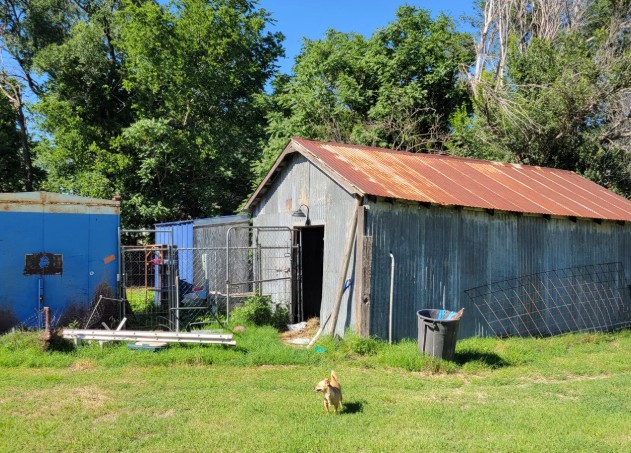
The west wall of our barn — Boomer was supervising the property assessment. This is our backup bat house location if the south wall of the house doesn’t work out.
The winner — south wall of our house: South facing, tall enough, and it overlooks the garden. Bats patrolling the garden at dusk means free pest control for our vegetables — which honestly we need this year because the goats figured out how to open the garden gate and have eaten half of what I planted. The south wall of the house checks every box and it’s where ours is going.
🦇 My Mom’s Property Next Door — Near the Goat Water
My mom is my neighbor and she has the bigger mosquito problem — her goats have larger water tanks and more standing water overall. We’re putting a bat house on her property too, and her situation is actually simpler than mine because she has multiple barns to choose from.
The strategy for her placement is different from mine. Instead of starting with the buildings and working backward, we started with the water source — because bats prefer to roost within a quarter mile of water, and the closer the roost is to the water source they’re hunting, the better.
Her goat water tanks are the breeding ground we’re trying to address, so we’re mounting her bat house on whichever barn wall has the best south or southeast exposure closest to where the goats drink. That puts the bats right where we need them — hunting the mosquitoes at the source before they ever make it to the house.
🦇 What to Do When None of Your Buildings Work
After walking our property I have a lot more sympathy for people who end up needing a pole mount. If we hadn’t had a south-facing house wall that worked, we would have been in trouble — the shop was a complete strikeout on all four sides and the barn’s best wall faces west.
A telescoping pole kit solves every building problem at once. You plant it in open ground, choose exactly the right compass direction, get the exact height you need, and position it near the water source without being limited by where your buildings happen to sit. It’s the most controlled placement option available.
The tradeoff is cost and installation effort — you’re digging or driving a ground socket, and the pole itself is an additional purchase on top of the bat house. But if your property layout doesn’t give you a good south-facing wall at the right height with clear flight paths, the pole kit is absolutely the right call and skipping it to save money will cost you a colony that never arrives.
→ Deerdtride 15 FT Pole Kit on Amazon
🦇 Bat House Placement Checklist — Before You Drill a Single Hole
| Requirement | Ideal | Acceptable | Avoid |
|---|---|---|---|
| Direction | South or Southeast | East or West | North |
| Daily Sun | 6–8 hours direct sun | 4–6 hours | Less than 4 hours |
| Height | 15–20 feet | 12–15 feet | Under 12 feet |
| Flight path below | Completely open | Mostly open | Fences, shrubs, branches |
| Distance from trees | 20+ feet | 15–20 feet | Under 15 feet |
| Mounting surface | Building wall or pole | Sturdy post | Tree trunk or branch |
| Distance from water | Under 1/4 mile | 1/4 to 1/2 mile | Over 1/2 mile |
| Activity/noise nearby | Quiet, undisturbed | Occasional activity | Bay doors, heavy traffic |
🦇 What to Expect the First Season — Be Patient
I want to set honest expectations here because I’ve read enough forums to know that a lot of people put up a bat house, check it two weeks later, see nothing, and conclude that bat houses don’t work. That’s not how this goes.
Bats are creatures of habit and they’re cautious about new roosts. It can take one to two full seasons before bats discover and move into a new house — especially in areas without an existing local colony to spread the word, so to speak. Some people get lucky and have bats within weeks. Most wait at least one full summer.
The things that speed up adoption are exactly what we’ve already covered — correct sun exposure, right height, clear flight path, close to water. Get those right and you’ve done everything you can do. Then you wait.
We’re going into this with realistic expectations. The houses are going up this summer. I’ll report back in Post 3 with whatever actually happened — whether that’s a thriving colony, a few scouts checking it out, or an empty house and a lesson learned.
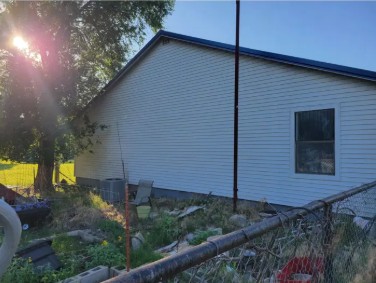
The south wall of our house — the winner after walking every building on the property. Plenty of height, faces the right direction, and overlooks the garden below.
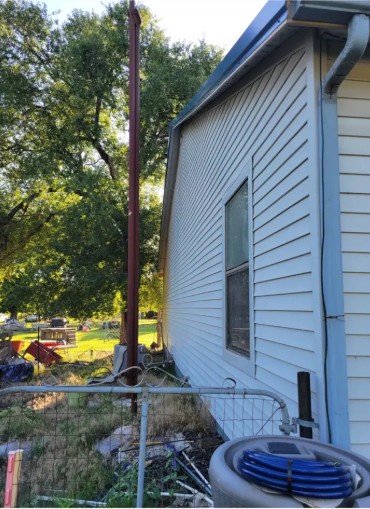
The corner view showing just how much height we’re working with. And yes — that pole used to hold an antenna. Now it just stands there looking important and we’re afraid to touch it.
🦇 Why You Might Not Be Seeing Bats Anymore — White-Nose Syndrome
My husband mentioned he hasn’t seen bats around our property in a few years. I’m hoping it’s just that he spends less time outside at dusk than he used to — but it’s also possible there’s a bigger reason, and it’s worth knowing about before you wonder why your bat house stays empty.
White-Nose Syndrome is a fungal disease that has devastated bat populations across North America since it was first detected around 2006. The fungus grows on bats during hibernation, disrupting their sleep and causing them to burn through their fat reserves before winter ends. Some hibernating colonies have lost 90 to 100 percent of their population. It’s one of the most significant wildlife diseases ever recorded on this continent.
If your local bat population has been affected, it may take longer than one season to see results from your bat house — and that’s not a reflection of your placement or your house. It’s a reflection of a much bigger problem that bat houses actually help address by providing safe, warm roost sites that support whatever bats remain in your area.
✓ Put up bat houses — provides critical roost sites as natural habitat disappears
✓ Reduce or eliminate pesticide use in your yard and garden — kills their food supply
✓ Leave dead trees standing when safe — natural roost sites that bats have used for generations
✓ Keep outdoor cats inside at night — cats are significant bat predators
✓ Turn off unnecessary outdoor lights at night — bright lights disrupt their hunting patterns
✓ Report bat sightings to your state wildlife agency — population data helps researchers track recovery
🦇 A Word About Bats and Rabies — What You Actually Need to Know
I know what you’re thinking because I thought it too — what about rabies? It’s a fair question and worth addressing honestly before you put a bat house on your property.
The reassuring truth: Only about 1 to 2 percent of wild bats carry rabies — much lower than most people assume. A bat colony living in a properly mounted outdoor bat house poses virtually no rabies risk to your family or pets. The danger is not the colony overhead — it’s direct contact with a sick or grounded bat.
What to watch for: A healthy bat you will never get close to. A bat that needs to be concerned about is one you find on the ground, flying in daylight, or acting disoriented. Those are signs of illness. Leave it alone and call animal control.
Can you vaccinate bats like foxes? I actually looked into this because the USDA does distribute oral rabies vaccine baits for foxes, raccoons, and coyotes in certain areas — and it’s been really effective at reducing rabies in those populations. Unfortunately there’s no equivalent for bats. They’re insectivores that hunt live insects in flight, so there’s no bait delivery system that works for them. Rabies management in bat populations comes down to public education and pet vaccination — not population treatment.
✓ Keep dogs and cats current on rabies vaccination — Boomer and Ollie are already on our list
✓ Never handle a bat with bare hands — even if it looks healthy
✓ Teach kids that a bat on the ground is not a pet and not to be touched
✓ If anyone is bitten or scratched, seek medical attention immediately — post-exposure treatment is very effective when caught early
✓ Watch the bat house from a distance at dusk — that’s close enough
Just getting started with this series? Read Part 1 first: Why I Put Up Bat Houses Instead of Buying a Mosquito Fogger — including a comparison of four bat houses at every price point.
Find Your South Wall First
Before you order a bat house, walk your property with a compass app on your phone. Find every south and southeast facing wall. Check the height. Look for tree proximity. That ten minute walk will save you a season of waiting on a bat house that was never going to work where you put it.
We’ll be back with Part 3 once our houses are up and we have real results to share. Fingers crossed we have some new neighbors by late summer. 🦇
Where did you end up mounting yours? Drop a comment — I’d love to hear what worked on your property!